
Eating Dandelions
Before we had lawns, before cities became vast expanses of concrete and dwellings with little or no green spaces, we had gardens, specifically what we now refer to as ‘cottage gardens’ that served as both pantry and pharmacy. The dandelion was not only welcome in a cottage garden, it was an essential component. Medieval and Renaissance households and monasteries actively grew dandelion alongside their vegetables and culinary herbs. It is after all plant that grows robustly and abundantly, self-seeds, needs little to no nurturing other than water in a dry summer, and provides both food and medicine.
History
The name ‘dandelion’ is remarkably descriptive. The word derives from the French ‘dent de lion’ meaning ‘lion’s tooth’, describing its plant’s serrated leaves. French was the language of the English Court from the Norman invasion in 1066 until the early 16th century. The names of many foods in modern English are actually derived from the mediaeval French. Examples of this are pork, beef and mutton. I suggest that ‘dent de lion’ was also a commonly consumed food, even at royal dining tables!
The general populace didn’t speak French, and gave the plant much plainer but very descriptive names: pissabed, wet-a-bed, pissenlit in French. Names that told you, plainly and without euphemism, exactly what the plant does, . In folk medicine, a name like that is not an insult, it’s an indication of its common usage.
Karolus Linnaeus pubished ‘Sistema Natura’, his classification of plants using latin designations, in 1735. Dandelion is one of the plants included, which again indicates that it was commonly known and widely used. Linnaekus chose the term ‘Taraxacum’ which likely derives from the Arabic tarakhshaqūn, meaning bitter herb. This is likely inspired by the work of ibn Sina And, here’s where it gets interesting, the species name, ‘officinale’, means ‘of the apothecary’s shop.’ This was a plant kept in stock by apothecaries, who traditionally were both herbalists and pharmacists. In fact, even today, pharmacies are still known as ‘Apoteke’ pretty much everywhere in northern and eastern Europe. The ‘officinale’ designation clearly labels dandelion as a medicine. Something to be treasured, not trashed.
Herbal Traditions
Dandelion was described in Traditional Chinese Medicine, and the Greek (Hippocrates and Theophrstus), Persian (al Razi) and Arabic (ibn Sina) medical texts,. It figured in the first European herbal, the Ortus Sanitatis, published in 1485, alongside some 180 other medicinal plants.
William Langham, physician and herbalist, writing in his Garden of Health in 1579, recorded over thirty uses for dandelion. In his Herball (1597), John Gerard noted that the plant boiled “strengthens the weake stomacke, and eaten raw it stops the bellie and helps the Dysentery.” So a weak stomach would be supported by a bitter.
Nicholas Culpeper, radical and famously opinionated, writing in 1653 in the vernacular instead of Latin, made what was then current medical knowledge accessible to ordinary people, or at least, those who could read. Culpeper’s description of the physical therapeutic effects of dandelion is still spot on:
“It is of an opening and cleansing quality, and therefore very effectual for the obstructions of the liver, gall and spleen, and the diseases that arise from them… it wonderfully openeth the passages of urine, both in young and old; it powerfully cleanseth aposthumes, and inward tumours in the urinary passages, and, by during the temperate quality, doth afterwards heal them; for which purpose the decoction of the roots and leaves in white wine… is very effectual.”
Nicholas Culpeper, The English Physician, 1653, on dandelion
Astrology figured largely in 17th century medicine. Culpeper placed dandelion under the rulership of Jupiter: expansive, generous, nourishing, abundant. He used it for what we would today identify as impaired liver function – that sluggish, heavy, irritable state that many of us recognise in ourselves, particularly as we get older. He recommended it without hesitation and pointed out that it is growing in the fields around the house.
To do this was actually a radical political act. Already in the 17th century, the medical establishment was actively engaging in making the knowledge of ‘physick’ into a protected profession, monopolising diagnosis and treatment, driving out the wise women and folk healers, and making healthcare something you purchased from a professional rather than gathered from your garden. The witch hunts of the 16th and 17th centuries effectively criminalised wise women, midwives and healer, and also wise men who practised herbal medicine. Culpeper’s popularisation of herbal medicine was so threatening that the College of Physicians tried to have him prosecuted. Well well, who wouldh have thought that traditional wisdom was so revolutionary?
What was written down was the knowledge that could be homogenised and monetised. The seasonal rhythms of gathering a herb was of no value to a system that required a continuous supply year round. The energetics of a herb and the understanding of the pros and cons of different preparations, the apparently ‘intuitive’ knowledge of what would suit whom (which was likely based on a diagnostic skills that do not need a stethoscope, such as pulse at different points, skin tone and colour, oiliness/dryness of skin, posture or other physical characteristics) were deemed ‘superstition’, or witchcraft, ‘old wives’ tales’, or simply ignorance, and it was suppressed because male doctors saw little value in it.
In parts of Eastern Europe, the female healing traditions endured well into the 20th century. In her novel The Last Goddess, Czech writer Kateřina Tučková documents through a fictional characters how the communist state sought to eradicate the ‘superstition’ of traditional folk medicine as practised by women.
As a naturopathic nutritional therapist, I can categorically state that modern science now largely validates many of the old ways. Looking at someone’s face, tongue, skin texture, sweat patterns all give clues about their health, which are recognised physiological manifestations. Nevermind that traditions across the globe already knew this, the medical profession still largely treats the disease, not the patient.
Many modern drugs are based on laboratory-made copies of a single component of a plant. For example, aspirin is a synthetic version of salicylic acid, found in willow bark. It is now known that willow bark extract, that contains an array of phytochemicals, eases pain without causing the stomach irritation that aspirin in known for. Caution, do not go making home-brew willow bark extract if you don’t know what you are doing and/or safe doses. Dandelion extract is now available in some supplements. Again, take expert advice before self-medicating, especially if you are taking drugs, prescribed or otherwise.
The Nutritional Benefits of Dandelion
It’s likely that traditional healers would not have been able to express the actual chemical mechanisms by which dandelion has certain therapeutic effects in the scientific terms that we use today, but they certainly knew them. Centuries of observation clearly established cause and effect, and in all likelihood subtle differences in taste or texture or how the herb behaved in different preparations would all have given clues. Modern analysis has largely confirmed what generations of healers, many of whom were women, already knew.
Let’s start with nutrition, as eating to survive almost certainly came before eating to find a cure. Dandelion is a spring bitter. It grows early in the year, when the body is moving from winter ‘hibernation’ to spring vitality. And it supports spring cleaning, so to speak, stimulating the liver to detox, rev up digestion, and balance fluids. In traditional Chinese medicine, spring is the season of the liver and the gallbladder, the very elements that dandelion support. Spring is also associated with the element of water. I don’t think that is a coincidence.
Nutritional Profile of 100g uncooked dandelion leaves
This is a mightily nutritious ‘weed’:
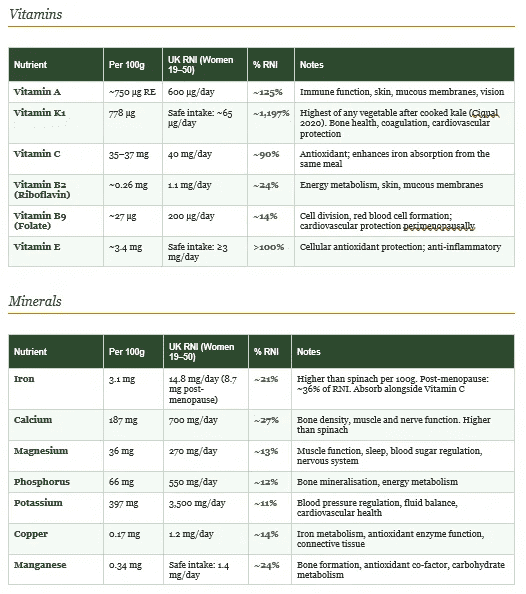
I would venture to suggest that one could call dandelion a superfood. Albeit one which has been deemed not worthy of cultivation or promotion, but nonetheless one that your great-grandmother likely would have gathered from her garden or foraged on common land for free. The juicy spring leaves grow at precisely the time when winter food stores were at their lowest, and the body most needs nutrition after a long winter (in times past!) of stored and salted food. Aragula or rocket, a commercially grown and milder tasting relative of dandelion, is now sold in many supermarkets at a price that would have astonished my grandma.
What I find remarkable is the inherent wisdom of nature: vitamin K, alongside vitamin D is an essential cofactor to bind calcium into bones. Vitamin C supports bone health through collagen synthesis. All these necessary nutrients delivered together in one edible plant. Iron and vitamin C: again, essential companions for maximum iron absorption in the stomach.
The leaves carry more iron and calcium than spinach. Dandelion greens are, after cooked kale, the vegetable with the highest Vitamin K1 content according to the French food composition database. They provide nearly five times your daily requirement of Vitamin K in a single 100g serving. Vitamins D and K act together to lock calcium into our bones instead of it floating around our arteries. Us perimenopausal women, and everyone contemplating their sixth decade and beyond, need all the help with bone strength we can get.
As well as vitamins and minerals, dandelion contains a number of potent bioactive compounds. Let’s start from the ground up.
Roots
The root, which is best harvested in autumn after the first frost, is rich in the prebiotic fibre inulin. This supports the liver, stimulate bile production, and ‘feeds’ beneficial bacteria in the gut microbiome.
Leaves
Dandelion leaf is renowned for its diuretic action. Like many plants, its action is nuanced: whilst it facilitates the excretion of excess fluid, it simultaneously maintains potassium in the body. Basically, it contains its own natural electrolytes. Most pharmaceutical diuretics deplete potassium, meaning that you need to replace it through supplementation.
The high fibre content of the leaves gives them a gently laxative action. Their bitterness, due to the presence of a family of chemicals called sesquiterpene lactones, supports liver function, and the body’s ability to detox.
Flowers
The deep yellow flowers are less well researched for their therapeutic potential. They have strong anti-oxidant properties (scatter a few on your salad!).
Oh, and don’t forget that sticky white fluid from the flower stems – my Gran swore by it to treat warts and minor skin lesions!
The Making of a Weed
So when did this extraordinary plant, which was used from China to Persia to the Mediterranean to northern Europe, was carried deliberately on the Mayflower as a therapeutic herb, then grown commercially by the Shakers in the nineteenth century, was available (in a number of different cultivars) in seed catalogues in the early twentieth century, become something most gardeners now actively eradicate?
“The difference between an herb and a weed is judgment.”
Sajah Popham
The answer is the fashion for the lawn. The perfect grass lawn is a late nineteenth/twentieth century invention. It’s the creation of a miniature of the manicured parkland gracing the grounds of many a stately home. Essentially, it’s a little bit of every man (and it was mainly men!) turning his home into a (tiny) castle. Burgeoning middle classes from the late nineteenth century onwards required housing; and Britain responded by producing row upon row of identikit houses with small front and back gardens, which were largely laid as lawn. Promoted as easy to maintain (are you kidding me? Hands up who enjoys mowing the lawn!), almost regulation in their uniformity, and a death zone for pollinators and wildlife.
The cottage garden, which had filled pantries and domestic coldrooms for centuries, became a symbol for a slovenly household, who couldn’t keep the lawn pristine. And woe betide anyone with the effrontery of contaminating the neighbour’s with those wayward thistledowns! And so folk were encouraged to poison it. This of course cost money and boosted the profits of the chemical companies. And it has decimated pollinators such as bees, the birds and small animals that eat seeds, poisoned the soil, and contaminated water through run off.
The Return of the Dandelion
Anyway, let’s get back to dandelions. The Royal Horticultural Society has made a small step forward in redesignating the dandelion as “a wildflower which plays a big part in the garden by providing food for insects and birds.” So no mention of food for humans there then! No Mow May is now a thing nationwide. Although it’s actually a centuries-old tradition on the island of Jersey, where hedges are not trimmed until mid-June. Foraging is trendy again, and putting wild food firmly back on the menu. Only last week I had a truly delicious dandelion, pear and walnut salad a the Reading Lido Restaurant.
But reclaiming the dandelion is not simply about adding it to your salad, though please do. It is about returning to the Hippocrates’ invitation to “let food by thy medicine, and let thy medicine be food”. This is a fundamental principle that women have known for years, whether through conditioning or through instinct: what you put in your body matters, and also that if you know where to look, you won’t go hungry. Good health is not something that we should hand over willy-nilly to someone else. It is something that we should proactively take individual responsibility for.
If you have enjoyed reading this, then I invite you to:
- if you haven’t already, safely dispose of the week killer, and learn to love your dandelions. They are the easiest thing to grow: just leave them to it!
- Go pick some dandelion leaves (where you are confident has not been sprayed, so probably not your local park). Pick a few young leaves , that are sweeter and slightly less bitter, and add them to a salad. Drizzle with olive oil and lemon juice. Savour the bitterness. And think of all that amazing nutrition you are eating.
- If you would like advice on changing your diet and/or supplementing with herbs especially to support digestive issues, then book a power hour with me, and I can help set you on your path to eating well. Click here to book.
I’ve collated the nutritional information on dandelion greens into a pdf. It’s available to paid subscribers at the bottom of the post; if you would like it anyway, it’s available to purchase for £3 here.
References:
- Culpeper, N. (1653). The English Physician / Complete Herbal. London.
- Gerard, J. (1597, rev. 1633). The Herball, or Generall Historie of Plantes. London.
- Langham, W. (1579). The Garden of Health. London.
- Miller, P. (1754, 1771). Gardener’s Dictionary. London.
- Grieve, M. (1931). A Modern Herbal. London: Jonathan Cape.
- Mills, S. (1991/1993). The Essential Book of Herbal Medicine. London: Arkana. [Cited in Yorkshire Herbalist monograph]
- Bradley, P.R. (ed.) (1992). British Herbal Compendium, Vol. 1. Bournemouth: BHMA.
- Gruszecki, R. et al. (2024). Multilateral Use of Dandelion in Folk Medicine of Central-Eastern Europe. Plants, 14(1), 84. https://doi.org/10.3390/plants14010084
- USDA National Nutrient Database — dandelion greens, raw.
- NLM Historical Collections (2016). “The Dandelion.” Circulating Now. National Library of Medicine.