
Before jumping on the band wagon of the latest darling of the influencer industry, let’s take a step back and have a look at what collagen is, what it does in the human body, and whether you really need to fork out on supplements that have rocketed in price thanks to the trendy brigade.
Safety reminder
The first point I need to restate, is that collagen is a protein. This means that if you have any form of kidney disease or renal insufficiency, then proteins, including collagen, are very much restricted for you. This is a reminder to consult with your medical practitioner before changing your diet or taking supplements.
Your kidneys are fine? Then read on, this is for you. Whether you are an athlete, or on your perimenopause journey, or you simply want to stay ahead of the health curve as you get older, then read on.
What is collagen?
Collagen is one of the most abundant proteins in the human body. It forms the framework of bones, cartilage, tendons, ligaments, muscle, blood vessels, gut lining, lungs and skin. It creates a flexible structure with immense tensile strength. It is a fundamentally important molecule for health, wellbeing and performance. So that means we need plenty of it, right?
Yes, we need it. But before we reach for the supplements, let’s dig into what makes up collagen.
Like all proteins, collagen is made from a number of amino acids, glycine, proline, hydroxyproline and hydroxylysine (hydroxy- means to hydrogen and one oxygen atoms attached to the amino acid), arranged in a particular helical pattern.
There are 20 amino acids.
Eight of them have to be consumed from the food we eat: are valine, isoleucine, leucine, methionine, phenylalanine, tryptophan, threonine, histidine, and lysine
The other 14 – alanine, arginine, asparagine, aspartic acid, cysteine, glutamic acid, glutamine, glycine, proline, serine, tyrosine – can be consumed in food, or the body can manufacture if we don’t eat enough of them.
However it is important to be aware that arginine, cysteine, glutamine, glycine, proline, and tyrosine are sometimes referred to as “conditionally essential”. This means that the body can usually make them, but may not produce the full amount that you actually need if you are ill, recovering from injury, under intense physical or emotional stress, or during hormonal upheavals such as puberty and perimenopause. This means that if your body doesn’t have the full optimal amount of these amino acids for every single metabolic function that needs them, it will prioritise the ones that are the most important for sustaining life.
Hold that thought, I will be coming back to this.
For the moment, think of amino acids as being like lego blocks of different colours.
You can assemble in different orders and in different patterns to make an infinite amount of shapes. The shapes amino acids form, when linked to other amino acids and sometimes other molecules entirely, make proteins. One such protein is collagen.
The amino acids that make up collagen are predominantly glycine, proline, hydroxyproline and hydroxylysine (hydroxy means that there is a water molecule attached to the amino acid). At first glance, these are non-essential amino acids, meaning that the body can make them itself. But, and here is the caveat: it can make them only provided it has sufficient intake of amino acids across the board. Here’s the thought I asked you to hold: glycine and proline are “conditionally essential”.
If you are not consuming enough overall protein in your diet, your body may lack the nutrients it needs to make collagen.
This means that in the long term, your body may not be producing enough collagen for repair and maintenance, let along for recovery from injury. The first place where the lack of collagen becomes noticeable tends to be the skin. As long as it still works as a permeanble membrane, the body is much less worried about how good it looks than our brains are.
How to ensure your body can make collagen?
The starting point isn’t the supplement jar, it’s appropriate nutrition. That means making sure that you have sufficient protein in your diet to meat your body’s needs.
The UK public health message is woefully inadequate where protein is concerned, based as it is on some hypothetical healthy person who is – well we don’t know for sure but presumably – bang on average BMI, who is fairly sedentary (because the average UK inhabitant doesn’t really move that much) and who is almost certainly neither an athlete nor perimenopausal nor in the upper half of the age percentiles.
If you are not that hypothetical individual, then you need to make sure that you are giving your body all the amino acids it needs. The more exercise you do, the more protein you need. The older you are, the more protein you need. And if you are on your journey through perimenopause, or that ship has sailed completely, giving your body all the help it can get through the food you put into it becomes a priority.
If you are a meat and/or fish eater, getting the amino acids you need to synthesize collagen is an easy task. One quarter of each meal should comprise a source of protein. The simplest way of thinking about this is to include a piece of solid protein at each meal: meat, fish, egg, good quality dairy produce, these will give you the full range of amino acids. Each snack you munch on should also contain protein (nut or seed butters, humous, cheese/curd cheese fit the bill here).
For the vegetarians and vegans among you, you are going to have to work harder. Solid soy products have a full complement of aminos – tofu, bean curd, tempeh, natto are all excellent choices. Soya mince is ok. As a complete aside, if you go for natto, do let me know how you get on with the taste. My husband’s friend, who tried it on a trip to Japan, described it as “like French kissing a German shepherd dog”, but was remarkably silent on what qualified him to give that analogy. Anyhow, I digress.
Quorn is, in my view, questionable. It is made from a lab grown fungus at the mould end of the fungal spectrum, not the mushroom end. If there is any possibility that you have any form of mould sensitivity for example from living in a damp environment, it is possible that quorn or similar products could aggravate that and/or trigger a reaction, as it potentially contains similarly structured proteins.
As for meat substitutes that are lab produced to look and taste like meat: these are highly processed foods using processes and often ingredients that you would not be able to obtain to replicate the product in a domestic kitchen. My view is very firmly that if a pea was intended to look like a chicken nugget, then nature would have made it that way. Eat the peas, not extruded the stuff.
Which brings me neatly to the next non-animal produce protein challenge, which is getting a full range of the essential and quasi-essential amino acids.
Not many plant foods contain all of them. Soy, quinoa, chia, hempseed and buckwheat all do have the full gamut of aminos. Everything else in the plant world only has some of them. So you need to combine your foods to make sure you get them all. The rule of thumb to remember is that you need to combine whole grains (rice, wheat, oats, millet, rye, spelt, einkorn, khorosan, etc) with pulses (lentils, chickpeas often called gram or besan, any kind of non-green bean). Some people say eating one or the other at some point every day is sufficient, I beg to differ.
The reason I recommend eating a combination of protein sources at every single meal is that plant sources of amino acids are less bioavailable than animal source. That means that it is harder for the body to extract and process them. So it makes sense to spread intake across the day rather than to rely on one meal to provide everything you need. Tryptophan and cysteine in particular are not particularly abundant even in grains, so I suggest that you need more than one grain source during the day to ensure your intake.
To put this into context, this graphic gives an idea of the differences in abundance of specific amino acids across pulses and grains as classes of foods. This is for visual reference: the actual abundance of amino acids in any given grain or pulse will be different.
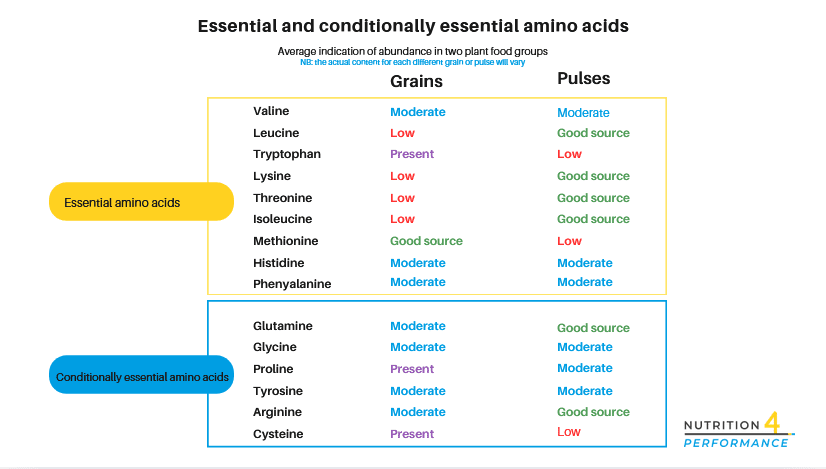
The other thing to be mindful of, is grains and pulses are significantly starchier than a portion of animal protein, so another potentially limiting factor is hitting satiety before you meet your desired intake for optimal nutrition.
Then if we take a look at the essential and conditionally essential aminos, we see that a couple of the components of collagen are on the list, namely lysine, glycine and proline.
To apply this to the structure of collagen, lysine is an essential amino acid, and glycine and proline are both conditionally essential. Remember, the latter means that if your body does not have sufficient building blocks for them, you need to consume them through in your food. Note that glycine is only moderately present in both grains and pulses, and proline is ‘present’ rather than abundant in grains whilst only moderate in pulses.
Why not just take a supplement?
The evidence starts getting sketchy around the actual efficacy of collagen as a supplement. There are plenty of studies, but many of them have a small cohort, in-built biases, and tend to be funded by the supplement producer. A couple of relatively recent review papers, which look at a number of individual studies, comparing their data and statistics and drawing out a wider picture, found there is an indication that long term collagen supplementation may be beneficial, but the statistical analysis shows a much less pronounced benefit than many individual studies suggest. There is also the suggestion – which matches what I have observed anecdotally in clinical practice – that you have to supplement for the long term to notice any meaningful difference. It’s not a quick fix.
To explore why this may be the case, let’s explore how the body processes collagen as a supplement. Any collagen that lands in the stomach will be broken down just like any other protein. The hydrochloric acid in digestive secretions and the proteases that break down proteins do not distinguish between a spoonful of collagen supplement or a piece of steak or a mouthful of beans on toast. They do their chemical work impartially and without singling any single type of protein for differential treatment. The stomach is very egalitarian in that way.
So by the time collagen leaves the stomach, it is not in the form of a fancy chain of molecules, it is in the form of amino acids, the individual lego blocks. What the body does with those amino acids is prioritised by essential to life first, and then what is left gets shared around other functions. I can’t find any research on this, but logically it makes sense that the needs of the organs without which the human body cannot function – brain, heart and lungs – get the first call on available nutrients. Skin, bones and joints play second fiddle.
Let’s look at what happens if you take collagen for skin health. If your food intake of protein is inadequate or outright deficient, I would suggest that you are less likely to see any improvement in skin or tissue from supplementing with collagen. If your intake is adequate, then you may see an improvement over time through taking a supplement. If you have a more than sufficient protein intake, then you may not see a difference simply because there is currently not much room for improvement.
Because of the popularity of collagen supplements in the influencer sphere, the price has shot up over the past year or so. My suggestion is that if you are a meat eater, up your meat intake on a daily basis, or have a couple of eggs for breakfast, and observe for a couple of months. This may be all you need to do. If you are still plagued with dry skin, and I admit that I fall into this category, then by all means supplement. You don’t need fancy stuff recommended by the celeb of the moment – look for a supplement made that places the emphasis on the source of the product rather than the name on the Instagram post. I’ve noticed better results on my dry skin with bovine collagen than with fish collagen. I like my supplement to be sourced from grass fed animals, with a traceable food chain. That way you know what you’re putting in your mouth.
I share my personal protocol with my paid subscribers below the paywall.
If you eat fish but not meat, you need to be eating your fish skin on to get a reliable collagen source from it. Fish source collagen supplements are made from the skin and bones of the fish.
Plant source collagen supplements exist, but are relatively recent creations so I can’t find any long terms studies on their effectiveness. Short term studies largely performed by the manufacturer are, of course, favourable. The main sources of plant collagen are either from algae, or from lab produced fermentations involving yeasts and bacteria. Before you go “yuck” remember that we all have guts full of beneficial bacteria, so that is not necessarily a nasty. There’s also a class of supplement that doesn’t actually provide collagen but claim to boost your body’s ability to synthesize it. I haven’t tried any of these products myself, so I can’t give a steer on which, if any, are better.
Collagen supplementation in whatever form you choose is not a quick fix. My own experience, which is of course purely anecdotal, was that I took a supplement daily, and saw a benefit, measured by how sore the skin on the back of my hands was, in about 8 weeks. If I stop taking collagen, my hands get sore again. This is entirely observational on one individual, so I am not claiming that it will work for you.
However, if you are satisfied your diet is adequate for your particular nutritional needs, then go ahead and give it a try. Providing you have healthy kidneys, it likely won’t do you any harm and it could well do you good. The studies I have looked at suggest that to derive benefit from supplementation, you need to commit to it for the long term, which obviously has a cost implication.
If you want to check that your diet suits your needs right now, then I can help. Book a Nutrition & Lifestyle Review with me.
Is high protein intake suitable for everyone?
As with everything, one approach is absolutely not suitable for all. So to reiterate what I wrote at the beginning:
If you have kidney disease, especially diagnosed chronic kidney disease or insufficiency, you should categorically not consume high levels of protein, nor should you take any form of protein supplement including collagen, creatine, whey, or supplements containing isolated amino acids. Consult with your medical practitioner and nephrology team, and follow their advice, not anything you discover on the internet.