
Australia has recently banned supplements that contain more than 50 micrograms of vitamin B6. The public knee jerk reaction has been, predictably, outrage at what is perceived as government interference with complimentary healthcare.
However, this is justification for caution with this particular vitamin. Read on and I’ll explain why.
I’m also offering my Protein Packed Breakfasts ebook for free, if you need inspiration for food to start your day the best possible way. Follow the link to download your copy.
What is vitamin B6?
Vitamin B6, also known as pyridoxine, is part of a group of water-soluble vitamins known as the Vitamin B complex. These are chemically different from each other, and have different actions in the body. B6 is an essential for:
- Nervous system function
- The transport of iron in the blood
- Sleep, through enabling the peptides such as tryptophan to work
- Energy, as it is used in energy production at a cellular level
- Hormone function
Sounds like a good thing, right?
It is absolutely essential, BUT in the right quantity. To much, and you feel sub-par. Too much, and you also feel lousy.
And here is the real kicker: the symptoms of too little and too much are pretty much the same: fatigue, lack of energy, anxiety, tingly hands and feet. All the things that it is supposed to help with.
The NHS recommended daily intake for vitamin B6 is 1.4mg per day for men and 1.2mg per day for women. The EU sets it much lower at 25mg per day. The reason for this is that at high doses, vitamin B6 is toxic and can cause nerve damage, initially manifesting as numbness in the extremities. Keep up the high doses, and this can become permanent. Australia’s new guidelines sit halfway between the two at 50mg per day.
Unlike with most of the B group vitamins, which the body simply excretes if you ingest too much, B6 has to be broken down for excretion. If you take high doses consistently, then it may accrue in the body as it can’t be processed fast enough. And it is actually quite easy to be taking too much, without even realising it.
Nerve damage due to B6 poisoning is quite difficult to diagnose, as there are many other common conditions such as type 2 diabetes that can cause similar symptoms. It’s not the first thing a GP would look for in a patient.
Dietary Sources
If you eat meat, it’s very likely that you get enough B6 from your food. If you have a colourful and varied vegetarian or vegan diet, you can still get plenty of B6. It’s found in:
- Pork, chicken, turkey
- Organ meat such as liver from all animals
- Salmon (especially wild salmon)
- Tuna
- Milk and dairy produce
- Potatoes
- Bananas
- Green leafy vegetables
- Broccoli
- Peanuts
- Soya
- Oats
- Whole grains
So if you are eating a varied diet, you really don’t need to supplement. It’s also thought that the gut microbiome may secrete some pyridoxine, which contributes to your overall levels. However, this is difficult to measure with any accuracy.
In addition to that, many breakfast cereals are fortified with vitamin B6, as are many smoothies and energy drinks. This is where the alarm bells start ringing.
When does it get toxic?
Essentially B6 works in what is known as a ‘J curve’. This means that symptoms improve up to a point when taking the vitamin, and then start getting worse again as the dose is increased or maintained over too long a time frame (see diagram below).
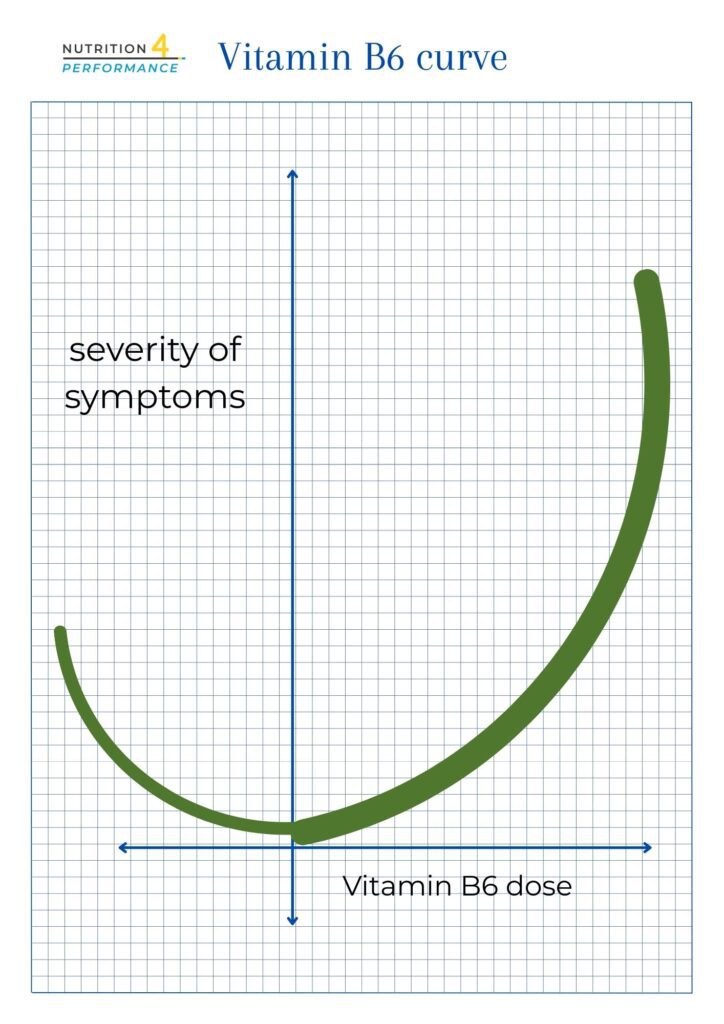
It can’t be that easy to overdo it, can it?
Well yes, it can be scarily easy.
I have in front of me a bottle of smoothie from a well-known UK brand, available as part of a meal deal in an equally well-known supermarket. The bottle is 300ml. The labelling is aimed at obfuscation. In very small print, it states that the bottle contains two servings. It lists the nutrient content for the statutory 100ml, and for one serving, ie half the bottle.
One serving contains 0.67mg of vitamin B6, or 48% of your daily recommended intake. Drink the whole bottle, and you have nearly all of an adult’s daily intake. Imagine you are taking a run-of-the-mill multivitamin which provides you with 100% of your daily intake as well. You’re already at twice the daily intake, without even starting looking at what you’ve eaten in your food. Sports drinks are of even bigger concern, because they come in bigger bottles, and it’s not uncommon to see people chugging back more than one per day.
Surely this is just scare-mongering?
No, it isn’t. In my practice, I have come across a case I suspected involved vitamin B6 toxicity. I never found out for sure, because the person was so convinced that high doses of vitamin B6 were helping with the fatigue impacts of a chronic condition, they were not open to exploring that it wasn’t any more. I believe that they had started taking B6, seen an initial improvement, so started upping the dose. When they came to me, they were in the middle of a relapse of the condition and bone-numbing fatigue. Whilst I do think they had initially needed extra vitamin B6, they were, in my view, at that point massively overdoing it, to the detriment of their health.
In this particular case, the old adage that you can have too much of a good thing rings true.
Can you test to find out if your levels of vitamin B6 are adequate?
Yes, you can. However, the direct blood test for vitamin B6 is not easy to access and it is expensive. The result that you get will reflect pretty much what you have eaten in the previous 24 hours or maybe even less. There is a urine test that looks at metabolites, ie the waste products, of a number of nutrients in a urine sample. This gives a slightly better picture as it shows how effectively your body is processing nutrients. Again, it is reflection of your diet over the previous 36 hours, but taken with a reliable record of what you have eaten, in my view it gives a better representation of where you B6 levels are. However, it is not a cheap test, so unless you have good reason to want to look at a number of potential excesses (usually heavy metals) and insufficiencies, it’s of questionable value for just one item on a list of more than 50 included in the test.
Do you need to supplement your vitamin B6 levels? If you are eating a balanced and varied diet, probably not, because you are likely getting enough from your food. If you diet is not balanced and/or varied, we need to have a chat. Likewise, if you suffer from a condition that leaves you exhausted, I recommend seeking support with your diet before reaching for the supplements.
To avoid overdoing it, enjoy the occasional smoothie or energy drink if you like, but don’t make them part of your every day routine. If you’re eating the kind of breakfast cereal that is fortified (ie it’s a nutritional void without the fortification!), maybe it’s time to rethink your first meal of the day – grab my free protein breakfasts ebook for inspiration! Click here to download it
If you think you do need to supplement any vitamin or mineral, then it’s time to book a Power Hour with me. I can look at your diet and lifestyle, any medicines you are taking, your current supplement regime, and make some bespoke recommendations for you. You can find out more about how I can work with you here.