
There is just so much misinformation out there!
Part 1 – energy intake
The media is full of often contradictory advice on what we should – and shouldn’t – be eating. Between advertising, influencers and articles on the latest trend, how do we really know what good nutrition really is? Is there an optimal diet? If there is, which one is it?
I don’t like the word ‘diet’. It has strayed a long way from its original meaning of a way of eating. It is now associated with faddy ways of eating, which are short term and promise miracles. Sadly miracles are not short term affairs. Lasting change in terms of eating in way to promote health, weight or wellness requires long term thinking and commitment.
Over my next couple of blog posts, I’m going to attempt to debunk some myths around food, and look at different ways of thinking about good nutrition.
Good nutrition has two elements:
- enough energy to sustain both your basal metabolic rate (the activity that your body does just to stay alive. This includes heart beat, breathing and all the metabolic processes over which we have not conscious control). On top of that comes the conscious activity that you chose to undertake. This activity is physical, mental and emotional. Did you know that the brain is the most energy-hungry organ in the body?
- Within that overall energy intake, there needs to be enough nutrition to enable the body to function optimally. Nutrition encompasses both macronutrients (protein, fats and carbohydrates) and micronutrients (vitamins, minerals and other compounds). These are all essential for the body to work.
So far, so simple. Let’s take a deeper dive.
Energy is measured as kilojoules or kilocalories. Already the ‘C’ word – in this context calories! – can be emotive. I remember my Mum being on various diets and attempting to restrict her calorie intake through most of my teenage years.
A benchmark of 2000 calories per day is subliminally burned into our brains in the UK. That is the figure against which most food products measure their contribution to the daily diet of a hypothetical average person.
Who is this hypothetical average person? Well it’s not me, and it’s almost certainly not you. It’s created from a statistical mean of public health data which was collected, as far as I can work out, in the 1950s. This is conflated with an assumed sedentary contemporary lifestyle, and presented as being every man and woman.
If you have the time and inclination, you could could have a trawl through the government publication on how its Scientific Advisory Committee on Nutrition came up with these figures in the SACN Dietary Reference Values for Energy. It’s a fairly turgid read, and bearing in mind this is supposed to be science, the word ‘estimate’ crops up quite a lot, starting in the index.
As a scientist, the word ‘estimate’ makes me bristle. Scientists are supposed to measure things, not take a guess, educated or otherwise.
The other flaw in the 2000 calorie theory is the assumption that all calories are equal. Well, in terms of energy, they are. 1g starchy carbohydrate provides 4 calories; 1g fat provides 9 calories; 1g protein provides 4 calories. However, in terms of micronutrient (ie vitamins and minerals) content, they vary significantly.
The ultimate starchy carbohydrate, refined white sugar, has virtually no micronutrients. Apart from providing energy in the easiest to access form for the body, it doesn’t support the body. Eat too much of it, and it will start causing some pretty serious problems.
Dietary fat is much more energy dense in terms of calories than either carbohydrates or protein. However, despite public health assertions to the contrary over the last 40 years, some dietary fat is essential to good health. Fat is required for the health of the brain and nervous system. The brain is actually 70% fatty compounds. Each nerve in the body is encased in a myelin sheath, which is made of fatty acids. Every single cell in the body has a membrane made of cholesterol molecules. Fat is required for the absorption into and transport around the body of vitamins A, D, E and K. And it is an essential component of the group of hormones known as steroid hormones: oestrogen, progesterone, testosterone, cortisol and thyroid hormones. Notice the common root of the words STERoid and choleSTERol.
The energy provided by protein is the hardest for the body to unlock, and is almost a last resort if there is nothing else available. However, protein provides amino acids, which are compounds the body needs to function. Amino acids are essential to the maintenance and repair of muscles, bones and skin – the body’s framework. They are essential for the production of hormones and neurotransmitters – the body’s messaging system. Protein is also an essential source of a variety of vitamins and minerals.
Moving on to micronutrients, these don’t provide energy, but they are crucial to every single metabolic process in the body. This includes how the body transforms the calories it takes in through diet to energy output in the form that keeps us alive and active. Without a range of vitamins and minerals, the body would not be able to metabolise macronutrients to function and to thrive.
So far, so good. We need a range of macro- and micronutrients in order to live a healthy life . So what is the best combination for optimal wellness?
This is where things get complicated, although really they shouldn’t be.
We hit that conundrum of not knowing how much of each type of nutrient we need as an individual. Are those public health recommendations optimal for everyone? Let’s take a look.
I’m taking as a starting point the UK public health recommendations for good nutrition as represented by the Eat Well Guide. I’ve put it here for illustrative purposes, not because I think anyone should follow it. For comparison, the BANT wellness solution graphic is below it, by way of comparison.
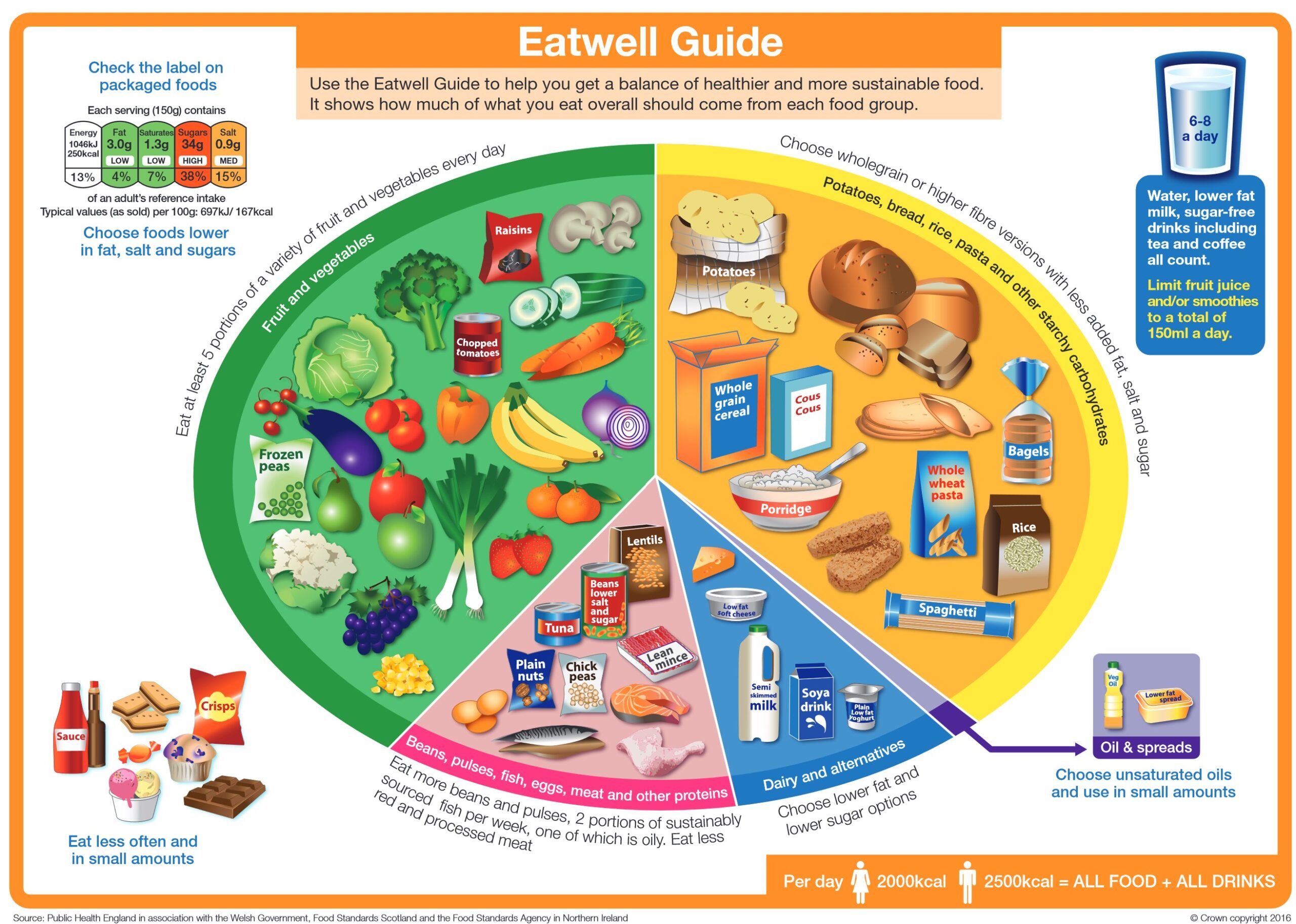
It’s recommending 2000 kcal per day for women and 2500 kcal per day for men. Fruit and vegetables figure prominently, but so do starchy carbohydrates. Dairy/dairy alternatives is separated out from protein. There is a strong low fat message. So let’s see if those recommendations stack up.
There are a number of different calculations that can be used to calculate individual energy requirements. These all use combinations of height, weight, sex, age, ethnicity and activity level multiplied by a factor which is designed to pull everything together in a way which gives the number of calories that the person needs to eat in a day. Once calculation needs an approximation of body fat percentage.
Rather than do a lot of maths long hand, I’ve used a platform called Nutritics to crunch some numbers on a couple of hypothetical people of have created to satisfy my curiosity.
Let’s start with Eva. Not her real name because she doesn’t exist. If she did, she would be 39 years old, 1.58cm tall and weigh 72kg. She would describe herself as lightly active. She wants to lose weight.
I put that data into Nutritics, and used the Henry Oxford 2005 calculation to work out her BMI and daily energy requirement. This is the calculation used for UK public health purposes. The number it came up with is 1960 kcal per day to maintain her current weight. It calculates her BMI as 28.8, which is deemed – by public health norms – to be overweight. Something isn’t adding up.
So the recommended energy intake comes out at fractionally under the public health recommendation, But hang on, this lady wants to lose weight. If I add that added piece of data into the calculation, to lose a steady 1/2 lb per week, she needs to reduce her calorie intake to 1700 kcal.
A little bit of digging reveals that the Henry Oxford calculation is thought to overestimate the energy requirement for older and for overweight individuals due to the assumptions it makes.
If I switch the calculation to the Institute of Medicine 2005 calculation, which is used for US public health calculations. This calculation suggests that eating 2000 calories per day would lead Eva to a very small weight loss over time.
Let’s have a look at what the calculator comes up with for an older man.
Meet the imaginary Bob, he’s 58 years old, 1.75m tall and weighs 83 kg. Again, he describes himself as lightly active. Bob’s wife thinks he needs to lose weight. Put those numbers into the machine and it calculates a BMI of 27.1 – overweight – and an energy requirement of 2402 kcal/day to maintain the same weight. This is the calculation that may overestimate caloric requirement, indicating that 2500 kcal/day is to high for a pretty average middle aged man.
The Institute of Medicine thinks he needs even less calories – 2365 kcal/day – to maintain his weight.
So I played with figures, knocked 20 years off his age, and got to approximately 2500 kcal/day to maintain – not lose – weight.
The various calculations are not perfect, and it’s important to be aware of their limitations. But it is also important to be aware of the limitations of the public health guidelines – unless you individually exactly match the characteristics of the hypothetical ‘average’ person, the guidelines are not particularly helpful in terms of the recommended daily energy intakes. If you are a woman or an older man, there is quite a big chance that you will eat more than you actually need, unless you are particularly physically active.
By way of comparison with the public health eating guide, hear is the one designed by my professional body, BANT – spot the differences.

BANT doesn’t put a caloric value on daily food intake, it focuses on proportions. Protein figures more prominently. I will dive into why in a future post. Starchy carbs take back seat to a good range of vegetables, with a couple of portions of fruit. Dairy is where is belongs, with protein. And there are specific recommendations on healthy fats.
If you would like help establishing what good nutrition looks like for you, click here to find out more about my service. You can book a no-obligation chat with me to discover how I can help you – click here to claim your slot.