
| The challenges of a qualified practitioner in an unregulated sector |
My peers in a practitioner group I am in are very worked up this morning about a person, holding out as a nutrition professional, who holds only a level 2 qualification. This is a high school level of education that is not intended to prepare people for professional practice. In addition, this person has registered a trade mark against a phrase that is commonly used in the context of nutrition. These two facts have caused a significant level of outrage.
Why is that generating so much heat? What is wrong with protecting one’s business and promoting one’s qualifications?
To answer those questions, I’m going to explore the structure of the academic qualification tree in the UK, and have a brief peek into the arcane world of trade marks.
What’s in a qualification
In the UK, the qualification levels align roughly with the usual pathway through school and university education.
Level 2 equates to GCSE standard. For those of you unfamiliar with the UK system, that is the standard required of a 16 year old. So a level 2 qualification in nutrition is essentially a course a teenager could take at school as an alternative to a GCSE. Such courses are usually offered as an alternative to academic study to teens who may be struggling with the more traditional subjects. They are also available to adults who dropped out of education and want to learn something.
My professional association, the British Association for Nutrition and Lifestyle Medicine (BANT) requires nutrition education to a minimum of level 6, ie a bachelor’s degree for new registrants. Until 18 months ago, it would accept applications from practitioners holding a level 5 higher national diploma, but no longer. I have completed a level 7 master’s degree in personalised nutrition, and a level 6 practice diploma.
However, I practice in an industry that currently only requires voluntary, not mandatory, professional regulation. This is partly because three different professional bodies cannot agree with each other that they cover different aspects of the same area.
Here’s a table showing how levels in education equate to the standard of learning:
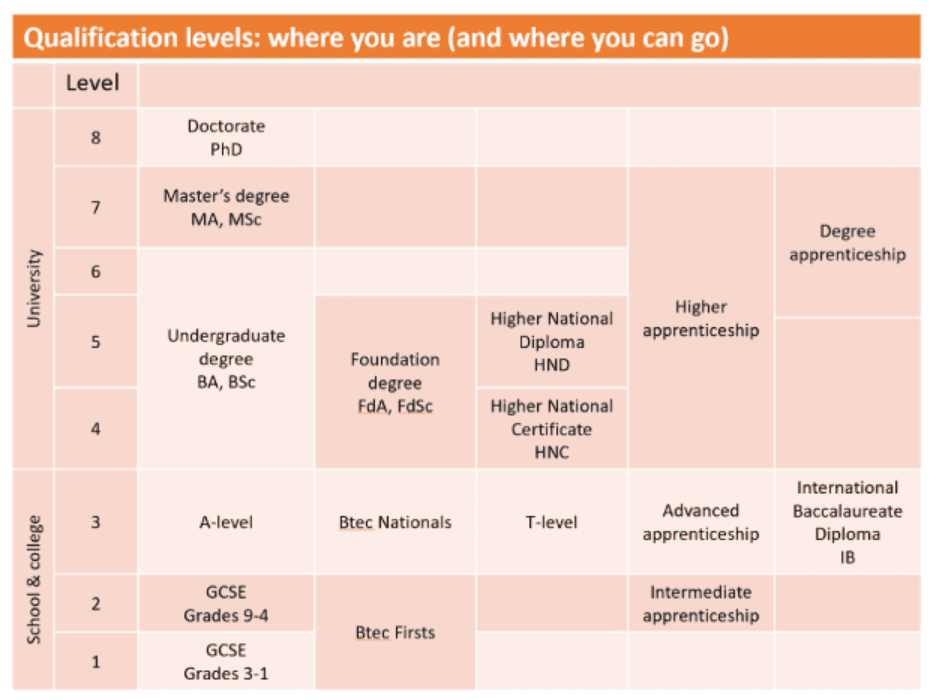
https://www.theuniguide.co.uk/advice/a-l 1
BANT
BANT registers and regulates nutritional therapy practitioners. This is my field. I am trained and competent to consider both nutrition and lifestyle, to use functional testing and to recommend supplements where appropriate. Nutritional therapy practitioners follow the functional medicine approach, looking at the whole person, and using detailed questionnaires backed up with face to face time to understand what is going on with a client. We are trained and licensed to make our own assessment of what a client is dealing with, although we cannot make medical diagnoses. BANT also licenses nutritionists that have completed BANT approved training. Which creates a certain tension with Association for Nutrition, because they don’t recognize our training.
AfN
Nutritionists are regulated by the Association for Nutrition (AfN). Their remit is to look at the composition of meals, and design dishes, menus and food plans for specific sectors of the population eg pregnancy, sport, etc. They are not trained or, in theory, licensed, to use functional tests or recommend supplements, but they frequently do. Theoretically, AfN registered nutritionists should abide by UK public health guidelines, but many do not.
One of my tutors actually put together the portfolio that AfN requires of practitioners who want to apply for registration on the basis of experience, and not having completed an approved training course. Her application was rejected on the basis that she uses functional testing and recommends supplements in her practice. So an AfN member who does this is actually breaking their own professional body’s rules.
BDA
Dietitians are the other category of nutrition professionals, regulated by the British Dietetic Association (BDA). This group of professionals work within the NHS, implementing set nutrition protocols under the guidance of doctors. They have the ability to get prescriptions for supplements signed off by the supervising doctor, but can’t make their own diagnosis or recommendations. They are obliged to work within NHS guidelines. A small number of dietitians work privately.
Commonality
The one thing all these bodies have in common is a minimum standard of education for members, which is across the board a minimum of level 5. However, there is at least one insurance company that will provide cover for people who have as scant a training as a £30 pdf based ‘training’ provided by an organisation that advertises widely on social media.
What does this mean for you as a client?
The big challenge is that in practice, members of the three bodies overlap in what they do. Those of us who are BANT registered, should specify ‘BANT registered nutritionist’, because our training is different to that of AfN nutritionists, and our scope of practice is different.
Instead of slinging mud at each other, personally I think working together would be preferable. Focussing on finding a way of formulating an overarching mandatory regulation would benefit the sector as a whole. This would remove the outrage amongst those of us who have invested time, effort and money in lengthy formal training from having to compete with being undercut but someone with a high school standard education. It could also oblige practitioners to respect their own scopes of practice.
Because this would make it easier for you to know that when you invest in working with a nutrition professional, the person you have chosen is truly what they hold out as being. In the meantime, my advice is check the qualifications and insurance of your chosen therapist. In the field of nutrition, there are many highly qualified individuals who have de-registered from BANT and AfN because of disenchantment with the way the two bodies squabble. If dietitians de-register from BDA, I believe they unable to practice as dietitians.
So what are you looking for? Do you want to work with someone who is qualified to work out what is going on in your body, identify possible factors contributing to the issues you want to work on and provide education, coaching and support to enable you to make changes that are appropriate for you? Do you need some meal plans to help you navigate nutritious eating in a way that works for you? Or do you want to follow the latest fad promoted by someone who has little knowledge and likely no training in how to apply it? The choice is yours. That is why it is important that you ensure that the person you decide to work with is qualified, ensured, and has a scope of practice that covers what you want to achieve.
By scope of practice, I mean areas that a practitioner is trained and qualified to work in. For example, BANT prohibits its members completely from working with individuals who have chronic kidney disease. This is because we could potentially do more harm than good. I choose not to work with people with eating disorders, because I believe that I do not have the expertise in terms of the psychological aspect to these conditions that would allow me to practice safely.
At the end of day, a person who has completed a rigorous training with clinical practice is in a much better position to work safely and effectively than someone who has a foundation standard level of education and a lot of chutzpah. The big risk with someone with minimal education, is that they don’t actually know enough to understand the limits of their expertise.
As the song goes “you pay your money, you make your choice”. I invite you to check the qualifications of any nutrition practitioner you engage to ensure that you are getting the best value you can get for your money.
What’s in a name?
That’s a good question. If the IPO, the body which registers trademarks in the UK, is willing to grant protection to a commonly used phrase. I’m not going to give you, I don’t want it to get boosted in the google rankings by people looking for it out of morbid curiosity. It is a phrase that, should it be legally restricted, would be hugely problematic for anyone writing a scientific paper, an article, a blog post, or any kind of social media commentary.
I have had a little look at the trade mark in question. I’m not a trade mark agent or lawyer, but I do have a little bit of knowledge of how protection works, having applied for my own trade mark myself with a little bit of education on the process.
It’s actually in the category!
It’s quite a convoluted system. You have to choose which categories to register the TM for. Each category has a number of sub-categories, some of which appear to overlap. So protecting a name in one category, say nutrition, would potentially protect the name that you use to carry on your business. However, it would not prevent someone from using the same word, words or phrase as the name of blog or a social media channel. Written publication, audio publication, video publication all have separate categories.
So I think the registration of protection for a business name does not prevent anyone from using that particular phrase in a different capacity. At some point – not imminently – I will use that particular phrase on something I publish, just to see what happens. Because something that is not specifically protected through choice of category is free for anyone to use. In fact, it is completely possible that the IPO refused to wide a protection where accidental infringement is only too possible.
So until anyone pulls me up on it, I will use whatever terms I choose in what I write. One thing you can be sure of, is that what I write is evidence based. I do the research so you don’t have to.
If you would like to find out more about working with me, book a no-obligation call with me here.