
Supporting digestion and immunity for winter wellness
Do your energy levels rise and drop like a roller coaster?
Does the thought of a mince pie give you indigestion?
Do you go down with a cold the minute you stop for the holidays?
Do you feel like the walking dead after a couple of late nights?
I gave a talk today on surviving the winter and more specifically supporting winter wellness through the festive season. Keep your digestion intact and avoid succumbing to every bug doing the rounds. So I thought that this is useful information for everyone, and why not share it here as well.
There are three key areas to focus on:
Focus 1: Digestion
Everything starts in with digestion. If it’s not working properly, it doesn’t matter how good the food you eat, you won’t get the full benefit of it.
Tip 1: Wake your stomach up before your eat!
It sounds obvious, but most of us don’t do that, especially when grabbing and eating food on the go. If food lands in your stomach unannounced, then your digestion is playing catch up, making it’s job more difficult.
Eating should be a sensory experience, not just a functional refuelling. Digestion starts in the brain, with the input of the senses stimulating the release of stomach acid and digestive enzymes.
Start thinking about food 20 minutes before you plan to eat. Think of what you are going to eat. Imagine the smell. Imagine the taste. Imagine the texture as you bite into it. Imagine your enjoyment of your food.
Tips 2: Step away from stress!
The nervous system needs to be in’ rest and digest’ mode to enable your digestive system to work. If you are running around stressed, then you’re in ‘fight or flight’ mode. In this state, blood is deviated away from your intestines and to your heart, lungs and muscles. So move away from your desk, put your phone down, and focus on your enjoyment of the food in front of you.
- Sit down to eat, and use a knife and fork. This gives you a wider variety of foods to eat. It’s hard to eat soup, or a salad, or meat that you need to cut up whilst standing or moving around. It also slows you down.
Tip 3: Prepare your food for your stomach!
- Chew each mouthful at least 20 times. Put your cutlery down between mouthfuls. Chewing does two things. Firstly, it breaks down food mechanically in preparation for chemical breakdown in the stomach. The smaller the food fragments that land in the stomach, the easier they are to digest. Secondly, digestive enzymes in the saliva start the chemical breakdown process.
If you can into the habit of doing this at every meal, then your body is much more likely to be able to maximise the nourishment it can absorb from the food you eat.
Focus 2: Immunity
What we put into the body is key to supporting the immune system. Ensuring that we consume appropriate levels of macronutrients, that is protein, fats and carbohydrates, for our age and level of physical activity.
This graphic from my professional body, BANT, gives a visual image of what proportions of different food groups make a balanced meal:
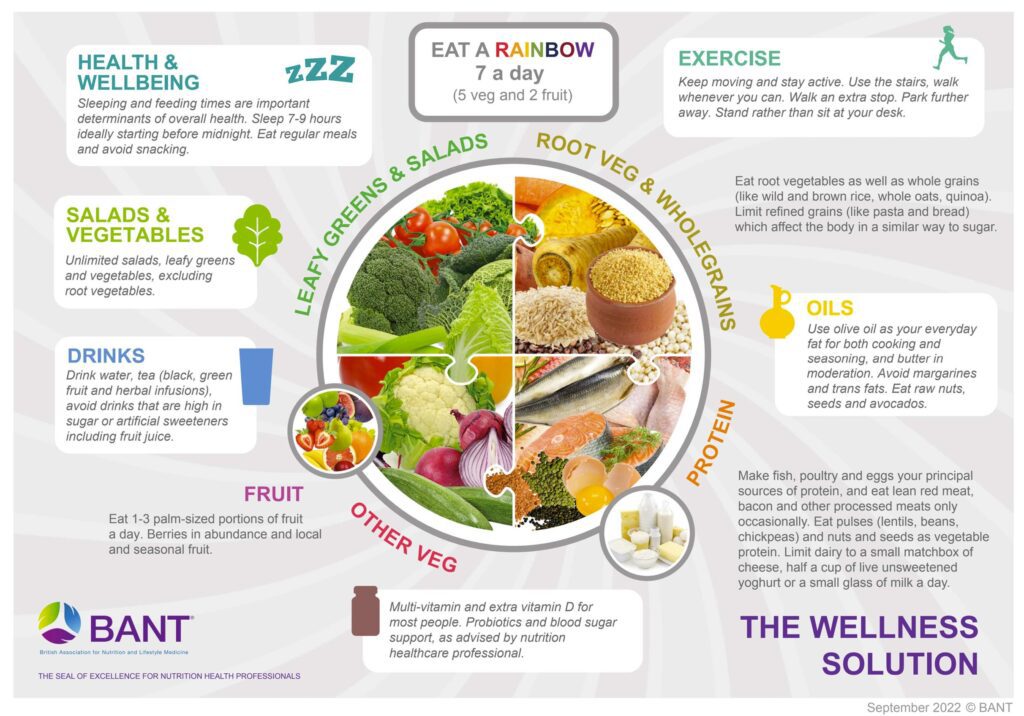
Tip 1: Variety
Within those food groups, we need enough variety of foodstuffs, especially vegetables and fruit, to provide all the vitamins and minerals we need.
| Nutrient | Source | Benefits |
| Vitamin C | Citrus fruit, kiwi, berries, tomatoes | Supports immune function |
| Zinc | Meat, dairy produce, nuts, seeds | Supports immune function and energy |
| Vitamin D | Sunlight, oily fish | Bone health and immune function |
| Probiotics | Fermented foods – kefir, kimchi, sauerkraut | Support gut heath |
| Fibre | Whole grains, vegetables, fruit | Supports digestion and gut motility |
| Magnesium | Nuts, legumes, spinach, whole grains | Energy support |
| B vitamins | Meat, legumes, whole grains, green leafy vegetables | Energy support |
Aim for a minimum of 6-7 different vegetables and fruit each day (3 fruit maximum because of the sugar content of fruit). Over the course of week, aim for a minimum of 20 different fruits and vegetables – experiment with new ones!
In the UK, there is insufficient sunlight to reach adequate levels from being outside, so supplementation is recommended. If you want to check your vitamin D levels, a cheap and reliable test is available from www.vitamindtest.org.uk is available. I have no affiliation, it’s an NHS laboratory with a little sideline.
Tip 2: Focus on protein
UK public health guidelines for protein consumption is based on 95% of an average population avoiding insufficiency. There is a lot of evidence to suggest that this is insufficient for most of us.
- I recommend including a good source of protein at each meal. If you eat meat and/or fish and/or dairy, it’s relatively easy to do this. If you are vegetarian or vegan, you need to think about it a bit more.
Proteins are made from various combinations of amino acids. There are 22 of these, 8 – the essential amino acids – of which need to be consumed through food.
Animal source protein contains all the essential aminos, very few plant foods do. Flax seed and quinoa are readily available plant options. To ensure you eat a variety of plant source aminos, combine different types of food: for example eating whole grains and pulses or legumes will provide the full complement. So, for example, dahl and roti, beans on toast, humous on rye crackers will provide the nutrients you need.
Tip 3: Eat a good breakfast
Granny was absolutely right when she said that breakfast is the most important meal of the day. My grandad always went to work having eaten a full English. I think starting the day with good meal is one of best ways to optimise winter wellness on cold dark mornings.
- The crucial nutrient to consume at breakfast time is protein, and some good quality fat. These both take longer for the digestive system to break down than carbohydrates, and are much more nutrient dense. This means that most people feel full for longer and are less likely to snack after a protein based meal.
The marketing power of the cereal manufacturers has been incredibly effective at convincing us that sweet and easy is the way to go in the morning. It isn’t. I suggest thinking of breakfast as a meal that counts towards your nutritional needs, and that savoury options are as good if not better than sweet ones.
Here are some suggestions:
- Omelette with spinach, tomatoes, mushrooms …
- Full fat plain yoghurt with no added sugar/sweetener granola, berries and nuts
- Tofu scramble with spinach, tomatoes, mushrooms
- Dahl and roti
- Smashed avocado on sourdough (optional egg)
For some more breakfast ideas, you can download my free ebook here
Focus 3: Stress Management and Sleep
The third essential consideration both for a strong immune system and for healthy digestion is relaxation and sleep.
As explained above, the body needs to be in ‘rest and digest’ mode for digestive processes to work efficiently, and the same is true for immune system function.
From an evolutionary perspective, humans are designed to slow down and hunker in for the cold season. Modern living does the opposite, with bright lights, endless school activities for the kids, and Christmas parties as the festive season revs up. Taking time to step back from the craziness of this time is essential for winter wellness (and for most of us for sanity as well!).
Tip 1: Respect your circadian rhythm
- Go outside as soon as you get up in the morning – or at least pull the curtains back and look out of the window.
I admit that going outside first thing when it’s cold, wet and miserable is not an attractive prospect, but my dogs need to go out if I don’t want puddles on the floor. Other than keeping my pooches happy and healthy, there are good reasons for getting out into daylight at different times of day.
Light receptors at the back of the eyes can sense the difference between light frequencies at different times of day. Early morning light triggers the release of cortisol first thing in the morning, waking us up and making us alert for the day. Bright midday light slows cortisol release, which will drop through the afternoon. Low angle late afternoon light stimulate production of serotonin and melatonin, preparing the body to slow down for sleep.
Trying to stay in touch with the natural cycles of daylight can be helpful for achieving restful sleep at the right time of day.
Tip 2: Routine
- Try to keep your bed time and rising time consistent. The odd late night won’t hurt you, but overall keeping regular hours helps maintain regular sleep.
There can be a temptation to sleep late and go to bed late on holiday. However, this can mess with sleep patterns, and when you go back to your normal routine, you may feel essentially like you have jet lag. This is a sure fire way to feel tired at the wrong time of day, and generally increase stress levels in the long term.
Tip 3: Self care
‘Me’ time is not selfish, is actually important, especially when life gets really hectic.
- Diarise some down time. This can take any form you like: coffee with friends, a yoga or pilates class, going for a walk, curling up with a good book. There is no right or wrong. It’s not selfish, you are doing this to support your health.
The nervous system can cope with intermittent bouts of stress. However, if a stressed state becomes the norm, this has a detrimental effect on both physical and mental health. Taking preventive steps to support your health now is on of the most valuable things you can do for yourself.
Conclusion
Individually all of these tips sound tiny and insignificant. However, if you implement them regularly and consistently, small actions lead to big changes.
Let me know how you get on!
If you would like support in making changes, and want to identify and work towards your personal health goals, then book an 1-2-1 Winter Wellness Power Hour with me. For just £97, I will spend an hour with you, exploring your personal health concerns and making personalised recommendations to enable you to optimise your wellbeing.
To view other ways of working with click here